
Is the Grand Egyptian Museum Worth Visiting?
Yes. The Grand Egyptian Museum is the largest archaeological museum in the world devoted to a single civilization, with the complete Tutankhamun collection, the colossal Ramses II statue and views of the Giza Pyramids. Allow three to four hours and book timed tickets ahead.
- Book timed tickets online in advance.
- Arrive at opening to beat the crowds.
- Allow three to four hours inside.
- See the Tutankhamun galleries first.
- Pair it with the Pyramids on the same day.
Imagine standing at the foot of a staircase lined with royal statues, a 3,200-year-old colossus of Ramses II behind you, and a glass wall ahead that frames the Great Pyramid as if it were a painting. That is not a movie set; it is the Grand Egyptian Museum, and it has quietly rewritten what a day in Cairo can look like.
For decades, travellers squeezed the Pyramids and a crowded downtown museum into one exhausting day. Now the two sit about two kilometres apart, and one of the world’s newest great museums gives the oldest wonders the stage they deserve.
This guide explains what it is, what to see, how tickets and hours work, and how to plan a smooth visit. If you would rather have the logistics handled, our Cairo day tours combine the museum, the Pyramids and a licensed Egyptologist in one easy day.
What Is the Grand Egyptian Museum?
The Grand Egyptian Museum, often shortened to GEM, is a vast museum complex on the edge of the Giza Plateau, built to house the treasures of ancient Egypt under one roof. It holds roughly 100,000 artifacts spanning prehistory to the Greco-Roman era, and it is widely described as the largest archaeological museum in the world dedicated to a single civilization.
Its star attraction is the entire Tutankhamun collection, more than 5,000 objects displayed together for the first time since Howard Carter opened the boy king’s tomb in 1922. Beyond the galleries, the complex includes a conservation centre, a children’s museum, conference spaces, gardens, cafés and shops, which is why a visit feels more like a small city than a single building.
It is also a statement of intent. Egypt wanted a museum worthy of its heritage, with climate-controlled halls, modern lighting and enough space to show pieces that had spent decades in storage. For travellers, the result is a far more comfortable and better explained introduction to pharaonic history than the older museums could offer. If you are planning a wider trip, our guide on how to plan your trip to Egypt shows where the museum fits into a complete itinerary.
A Short History of the Grand Egyptian Museum
The idea took shape in the early 2000s, when Egypt launched an international design competition for a new museum beside the Pyramids. The winning entry came from the Irish architecture firm Heneghan Peng in 2003, and construction began soon afterwards.
The project was long and ambitious, slowed by funding questions, political upheaval in 2011, and later by the pandemic. Its scale was enormous, from the giant atrium that had to receive an 83-ton statue to the specialist laboratories needed to restore thousands of fragile objects.
Progress arrived in stages. A partial opening in 2024 let early visitors see some galleries, and the official grand opening followed on 1 November 2025, when the Tutankhamun halls and the Khufu Solar Boat exhibit were completed. Today the Grand Egyptian Museum is fully operational, and it has become the headline attraction of any Cairo stay, which is why timing and booking matter more than they used to.
Architecture and Location
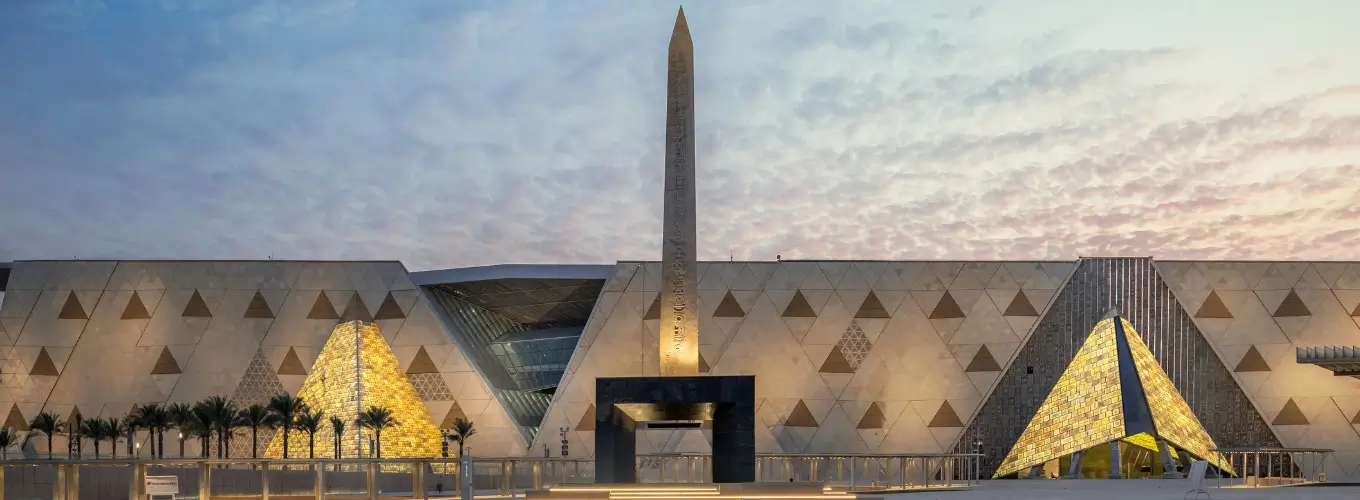
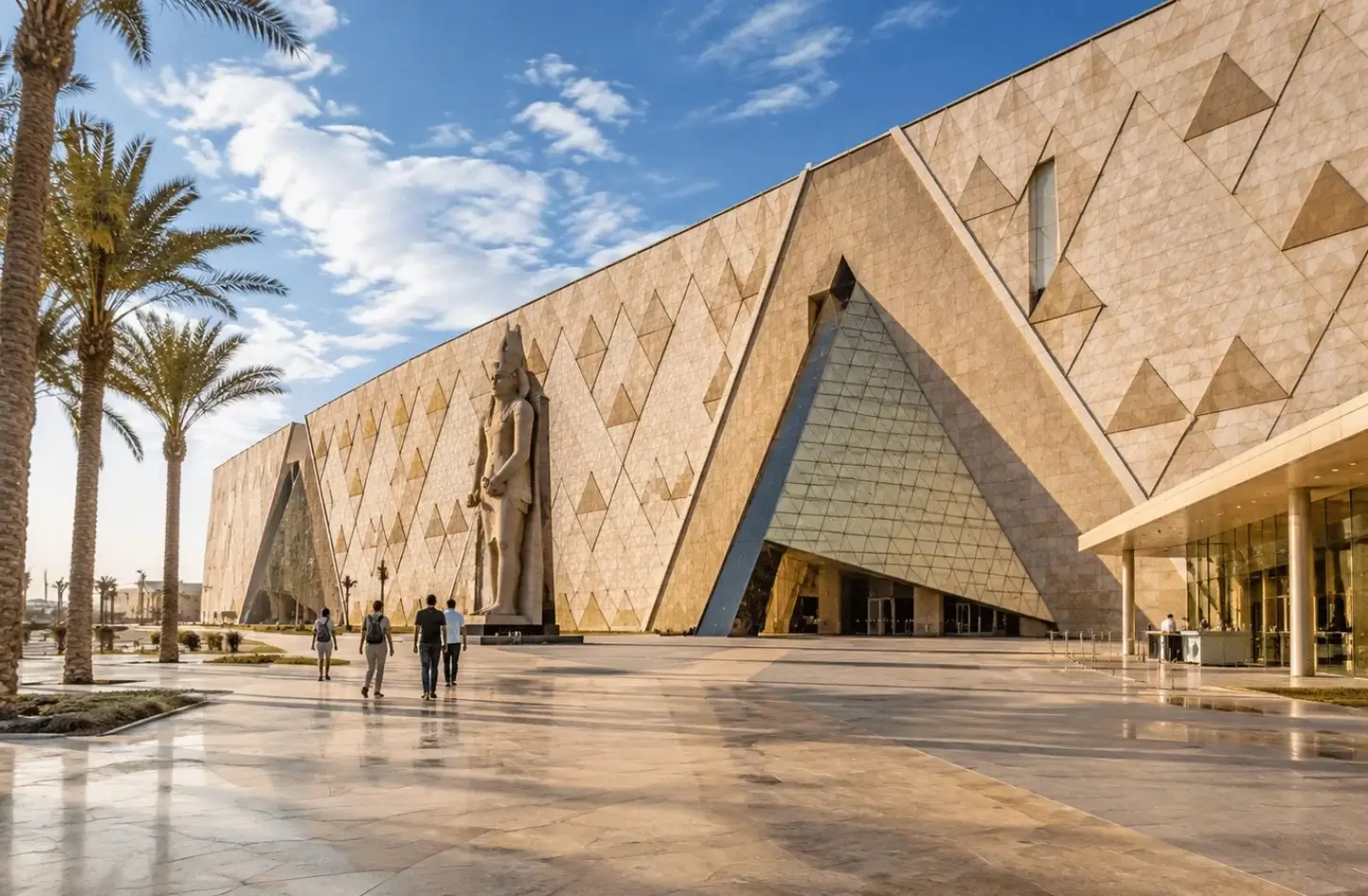
The building is as striking as what it contains. Its long, sloping facade is covered in translucent alabaster-toned stone and shaped with triangular geometry that echoes the Pyramids, while its axis is aligned to point toward them.
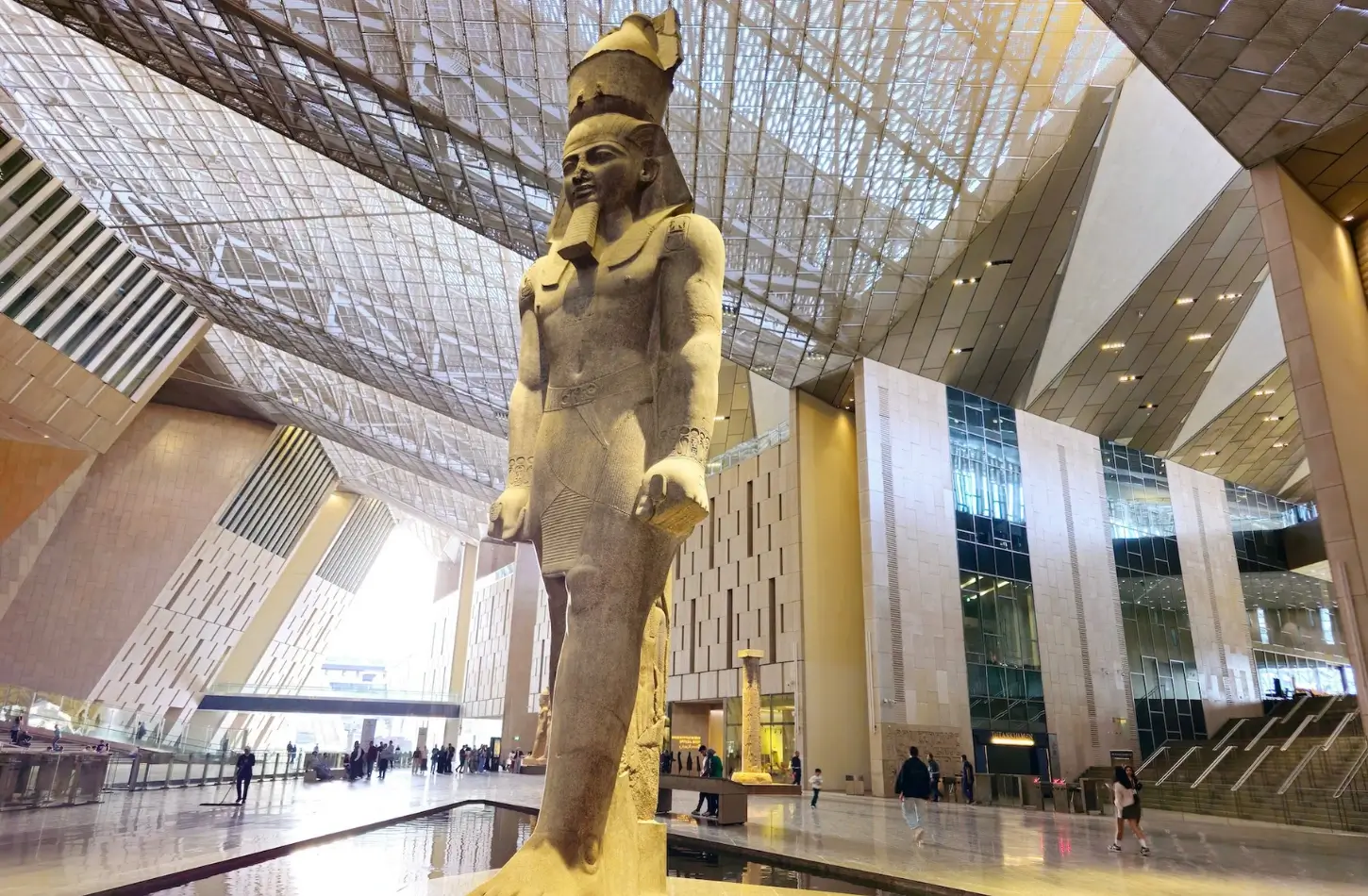
Inside, a soaring atrium leads to the Grand Staircase, and a huge window wall lets you see the Giza Pyramids from within the museum, a view that has become one of the most photographed moments in modern Egypt.
The setting is part of the attraction: the museum sits on the desert plateau roughly two kilometres from the Great Pyramid, so the ancient and the contemporary face each other across the sand.
Practically, this location is a gift. You can visit The Grand Egyptian Museum and the Pyramids in a single day with only a short drive between them, and your Giza hotel is likely to be within minutes of the entrance. For more ideas on what else to see nearby, read our guide to the best museums in Cairo, which compares the capital’s other collections.
What to See at the Grand Egyptian Museum
The collection is huge, so it helps to know the unmissable stops before you go. These are the highlights worth building your visit around:
The Ramses II Colossus
Your first encounter is one of the most dramatic. A statue of Ramses II, about eleven metres tall and weighing some 83 tons, stands near the foot of the Grand Staircase, greeting visitors as it once greeted travellers in central Cairo. It is a perfect opening photograph and a reminder of the scale of pharaonic ambition.
The Grand Staircase
Lining the broad staircase are dozens of statues of kings, queens and gods, arranged so that you climb through the centuries of Egyptian history. At the top, the glass wall opens onto the Pyramids, so allow time to pause and look. The upper galleries branch off here, making the staircase both the museum’s spine and its best viewpoint.
The Tutankhamun Galleries
This is the highlight for most visitors. For the first time, the entire collection from the tomb is displayed together, including the famous golden mask, the chariots, the shrines, the thrones and the personal belongings that accompanied the young king into the afterlife.
The layout lets you follow the story of the discovery and the burial in a logical order. Because these halls are the busiest, many guides recommend visiting them first or in the quieter hours of the day.
The Hanging Obelisk and Outdoor Spaces
In the entrance plaza stands the Hanging Obelisk, an obelisk of Ramses II that is displayed suspended in a way that lets you see its base, something rarely possible with obelisks. The outdoor terraces and gardens are worth a stroll, with sweeping views and benches for a rest.
Khufu’s Solar Boat
Roughly 4,500 years old, the ceremonial boat of King Khufu is one of the oldest and best-preserved wooden vessels in the world. It is now shown in a dedicated exhibit inside the museum complex, where its cedar timbers can be seen up close with explanatory displays about how it was found and reassembled.
The Main Galleries and the Children’s Museum
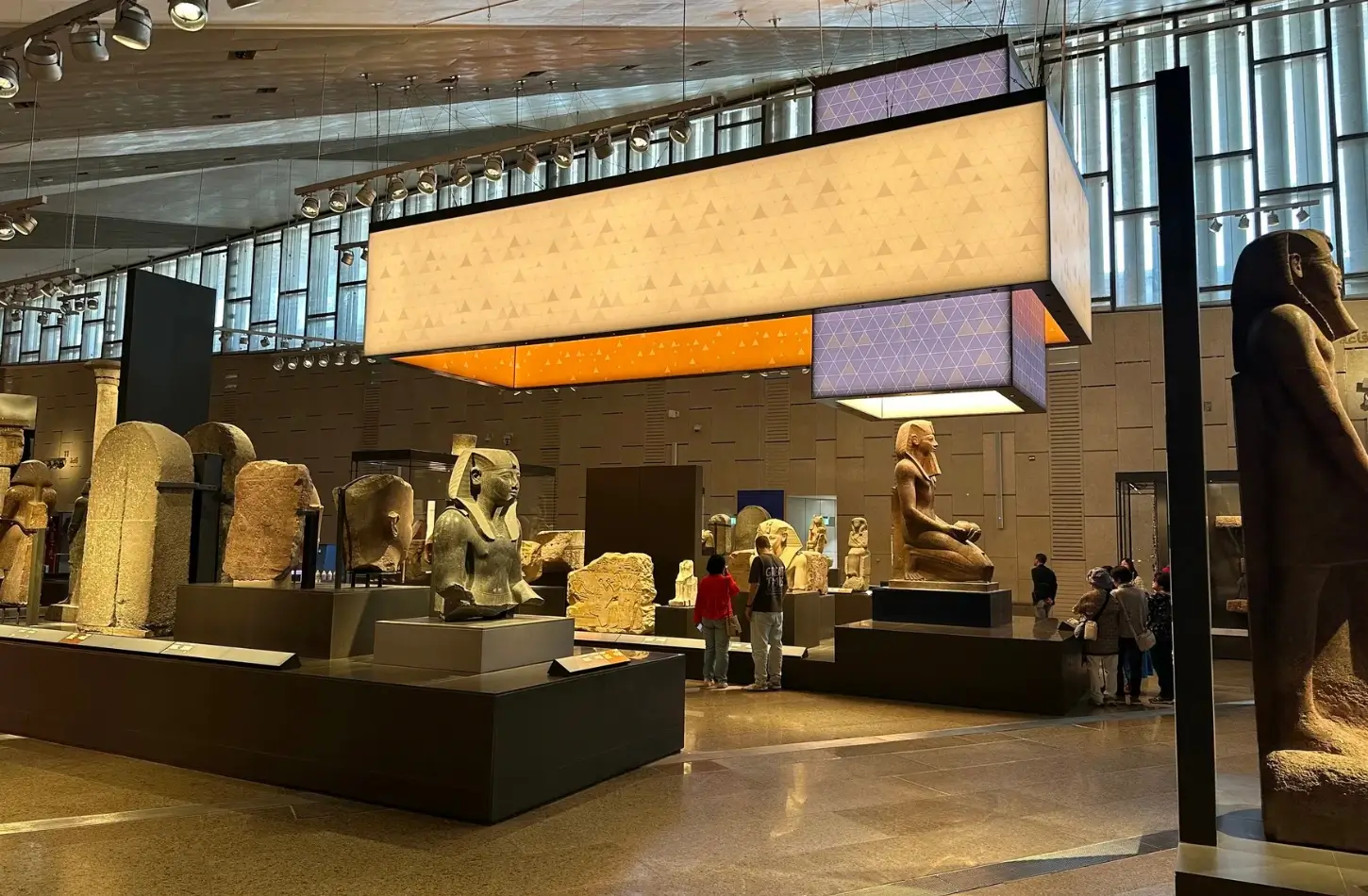
The permanent galleries are organised by theme and chronology, covering daily life, kingship, religion and the afterlife, with thousands of statues, coffins, jewellery pieces and papyri. Families can also try the children’s museum, which offers interactive workshops for younger visitors and is a good break for restless legs.
Grand Egyptian Museum vs the Egyptian Museum in Tahrir
Many travellers wonder whether they still need the older museum in downtown Cairo. The two are very different experiences, and the table below shows how they compare:
| Feature | Grand Egyptian Museum | Egyptian Museum (Tahrir) |
| Location | Giza, beside the Pyramids | Downtown Cairo, Tahrir Square |
| Style | Modern, spacious, climate-controlled | Historic 1902 building, more crowded |
| Star attraction | Complete Tutankhamun collection, Ramses II | Large classic collection, royal mummies nearby |
| Best for | First-time visitors and families | Dedicated history fans with extra time |
| Typical visit | 3–4 hours | 2–3 hours |
For most first-time visitors, the Grand Egyptian Museum is the better single choice, with the Pyramids close at hand. History enthusiasts with extra days may want to add the downtown museum and the nearby Islamic and Coptic quarters.
Grand Egyptian Museum Tickets, Prices and Booking
Tickets are sold in timed slots, and the best way to avoid disappointment is to reserve them in advance through the official online portal or through a licensed tour operator. Foreign adult admission has recently been listed at around 1,450 Egyptian pounds, roughly 30 US dollars, with reduced rates for students and children and lower prices for residents. Optional extras, such as an official guide, the Solar Boat exhibit or the children’s museum, may be priced separately.
Prices and policies are reviewed regularly, and the Egyptian pound moves, so always confirm the current rate at the time of booking rather than relying on an old figure.
If you prefer a stress-free option, booking a guided visit through us bundles admission, transport and an Egyptologist, so you skip the queues and get context for what you are seeing. Browse our current Egypt travel deals to see packages that include the museum, or build your own through our tailor-made Egypt tours.
Opening Hours and the Best Time to Visit
The galleries are generally open from about 9 a.m. to 6 p.m., with extended evening hours on some days, commonly Wednesdays and Saturdays, and shorter hours during Ramadan and in the low season. Because schedules change, check the official listing before you go.
As for timing, the quietest windows are usually the first hour after opening and the late afternoon, while mid-morning is when tour groups arrive. Weekdays tend to be calmer than weekends and holidays, and evening visits offer a peaceful atmosphere and lovely light on the Grand Staircase.
Season matters too. The cooler months from October to April are the most comfortable for combining the museum with outdoor sightseeing at the Pyramids, and they are also the busiest. Our guides to Egypt in January and the best time to visit Egypt explain how crowds and weather change through the year.
How Long Do You Need at the Grand Egyptian Museum?
Plan for a minimum of three hours, and four to five if you enjoy reading labels and stopping for coffee. A rushed visit can cover the headline pieces in about two hours, but you will miss much of the context. The museum is enormous, so wear comfortable shoes, pace yourself, and do not try to see every gallery. Choose the Ramses II statue, the Grand Staircase, the Tutankhamun galleries and one or two themed halls, and you will leave satisfied rather than exhausted.
A Perfect Day: Museum Plus Pyramids
Because the two sites are so close, a combined day works beautifully. This is a simple plan that many of our travellers enjoy:
Early Morning: The Pyramids and Sphinx
Start at the Giza Plateau soon after it opens, when the light is soft and the crowds are thin. Walk around the Great Pyramid, see the Sphinx and, if you like, take a short camel ride.
Late Morning to Afternoon: The Museum
Head to the Grand Egyptian Museum for a timed entry, beginning with the Ramses II statue and the Grand Staircase, then moving to the Tutankhamun galleries. Break for lunch at one of the on-site cafés.
Evening: Dinner and a Cairo Stroll
Return to the city for dinner and perhaps an evening wander through Khan el-Khalili. Our guides to Cairo shopping and the souks and local markets in Cairo will help you shop with confidence.
How to Get to the Grand Egyptian Museum
The museum is about two kilometres from the Pyramids and roughly 40 minutes to an hour from central Cairo, depending on traffic.
Taxis and ride-hailing apps are easy options, but a private driver or a guided tour is the most relaxed choice, because it removes parking and navigation worries and lets you move straight from the Pyramids to the museum.
If you are staying near Giza, you may be able to walk or take a short ride. Allow extra time on Fridays and during rush hour.
Visitor Rules and Practical Tips
Dress comfortably and modestly, in breathable layers, and wear good walking shoes, since you will cover a lot of ground. Large bags are usually restricted and security screening is standard, so travel light.
Personal photography is generally allowed in most areas, usually without flash, but restrictions can apply to tripods, professional gear and certain exhibits, so follow the posted signs and staff instructions.
Bring a refillable bottle, pace your day with a break at a café, and consider a guide for context, because a good Egyptologist can turn a long list of objects into a story.
Common Mistakes to Avoid
A few avoidable errors spoil otherwise great visits.
The first is turning up without a booking and finding the best slots gone.
The second is trying to see everything: the museum is so large that most people tire by the third hour, so pick your priorities.
The third is arriving at midday, when tour groups peak and the heat on the plateau is strongest outside the building.
The fourth is confusing the museum with the older downtown collection, which has different prices and a different location, so double-check the name on any ticket you buy.
Finally, do not forget a charged phone and a power bank, because you will take far more photographs than you expect.
Eating, Shopping and Nearby Attractions
Inside the complex you will find cafés, restaurants and gift shops, which are convenient for a mid-visit break. Prices are higher than in the city, so many visitors eat lunch near Giza afterwards, where family restaurants with Pyramid views are plentiful.
The museum shop sells quality replicas, books and jewellery inspired by the collection, a better souvenir than the mass-produced items sold at the gates.
Nearby, the Giza Plateau, the Sphinx and the Solar Boat area are all within a short drive, and the Saqqara and Dahshur pyramids make an excellent second-day excursion for travellers who love early history.
Accessibility and Travelling With Children or Older Visitors
The building was designed to be spacious, with wide corridors, lifts and ramps, so it is far easier to navigate than most older museums. Wheelchairs are generally available, and the Grand Staircase has alternatives for anyone who prefers not to climb.
With children, build in short breaks, use the children’s museum as a reward, and let them choose a few favourite objects to find. Older travellers will appreciate the benches and cafés, and a private guide can adjust the pace so that you see the highlights without rushing.
Is the Grand Egyptian Museum Worth It?
For nearly every traveller, yes. The collection is unmatched, the building is beautiful, and the experience is far more comfortable than the older museums. First-time visitors, families, photographers and history lovers will all find something to enjoy.
The main drawbacks are the size, which can be tiring, and the popularity, which means you should book ahead. If you want to combine the museum with the rest of the country, see how it slots into a classic itinerary through our Egypt classic tours, or add a river journey on one of our Nile cruises.
Frequently Asked Questions
Is the Grand Egyptian Museum open now?
Yes. After its official opening in November 2025 the museum is open to the public, including the Tutankhamun galleries and the Solar Boat exhibit, though schedules and policies can change.
How much time should I spend at the Grand Egyptian Museum?
Allow three to four hours at least, and up to five if you want to explore in detail and have a meal.
Can I buy tickets on the day?
Entry is timed, and advance booking online or through a tour operator is strongly recommended because popular slots can sell out.
Is the Grand Egyptian Museum good for children?
Yes. The spacious halls, the giant statues and the dedicated children’s museum make it family-friendly.
Is the Tutankhamun mask at the Grand Egyptian Museum?
Yes. The golden mask is part of the complete Tutankhamun collection now displayed at the museum in Giza.
Can I visit the Pyramids and the museum on the same day?
Absolutely. They are about two kilometres apart, so many travellers combine them in a single, well-paced day.
Do I need a guide at the Grand Egyptian Museum?
A guide is not compulsory, but a licensed Egyptologist adds a great deal of context, helps you prioritise the highlights and saves time, especially for first-time visitors.
Final Thoughts
The Grand Egyptian Museum has changed the way travellers meet ancient Egypt: one place, one story, and the Pyramids waiting just outside. Book timed tickets, arrive early, see the Tutankhamun galleries first and give yourself time to simply look up at the Grand Staircase.
When you are ready to turn this guide into a real plan, we can design the dates, pace and cities with you as a tailor-made Egypt tour, or you can start by browsing our full range of Egypt travel packages.
Ready to Experience Egypt for Yourself?
Let our local experts turn these ideas into an unforgettable journey — guided, seamless, and tailored entirely around you.