

Somewhere between Luxor and Aswan, the Nile does something it’s done for six thousand years: it slows everything down. Temples slide past on both banks, farmers still work fields the same shape they were in the time of Ramses II, and for a few days, the modern world mostly disappears. How you experience that stretch of river, though, depends entirely on the boat underneath you.
There are really only two ways to do it. A Nile cruise puts you on a multi-deck floating hotel with 50 to 150 other travelers, fixed schedules, and a pool on the sun deck. A dahabiya puts you on a small wind-powered sailboat with a handful of cabins, no fixed timetable, and a crew who will know your name by dinner on day one. Both sail the same river. Both stop at Karnak, Edfu, and Kom Ombo. The experience of getting there could not be more different.
Most guides on Nile cruise vs dahabiya stop at “cruise ships are bigger, dahabiyas are quieter” and leave you to figure out the rest. This guide goes further. Instead of listing features, we’ll match the boat to the traveler — because the honest answer to the Nile cruise vs dahabiya question is: it depends on who’s asking. If you already know you want the traditional sailboat experience, our dahabiya Nile cruise itineraries are worth a look; if you’re leaning toward a full-service ship, browse our Nile cruise options from standard to five-star. We’ll also flag which sites belong to each option, what things actually cost, and a booking trick almost nobody mentions: doing both on separate trips.
Quick Answer: Nile Cruise vs Dahabiya at a Glance
| Nile Cruise | Dahabiya | |
|---|---|---|
| Guests | 50–150+ | 8–20 |
| Power | Diesel engine | Sail, with a tugboat assist when there’s no wind |
| Route | Fixed, Luxor–Aswan (or reverse) | Same corridor, but with flexible stops |
| Pace | Structured, often sails at night | Slower, sails mostly by day |
| Price per night, per person | Roughly $100–$500 depending on star rating | Roughly $250–$1,000+ depending on the vessel |
| Onboard facilities | Pool, gym, spa, bar, restaurant, entertainment | Sun deck, small lounge, some have a plunge pool |
| Best for | First-timers, families, groups, fixed budgets | Couples, honeymooners, repeat visitors, slow travel |
| Access to smaller sites | Limited to major docking points | Can stop at villages and sites, larger ships skip |
That table settles the surface-level Nile cruise vs dahabiya question. The rest of this guide settles the real one: which of these fits you.
What Is a Nile Cruise?
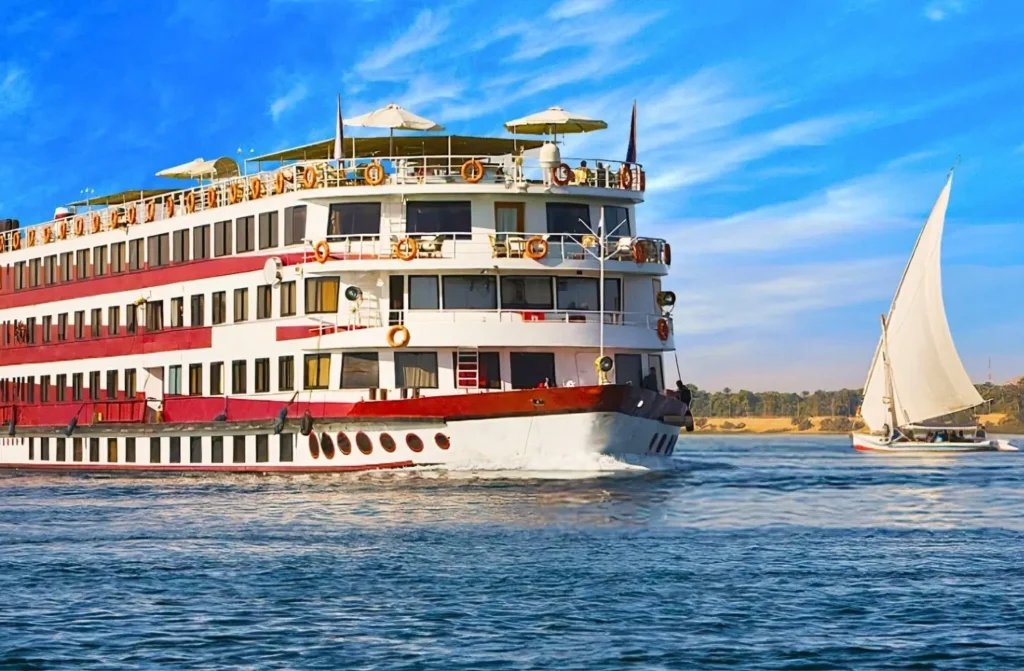
A Nile cruise ship is a purpose-built river vessel, usually four or five decks tall, designed to move large numbers of travelers comfortably along the Luxor-to-Aswan route (or the reverse) over three to seven nights. Think of it as a small floating resort: air-conditioned cabins with river-view balconies on the higher-tier ships, a buffet restaurant, a pool and sun deck up top, sometimes a spa or gym, and evening entertainment like a Nubian folklore show or a galabeya party.
The itinerary is fixed. You’ll typically sail overnight between destinations and wake up already docked, spending days visiting the major sites — Karnak Temple, the Valley of the Kings, Edfu, Kom Ombo, Philae Temple — with a licensed Egyptologist guide and a group of fellow passengers. It’s an efficient, sociable, well-tested way to see the highlights of Upper Egypt without any logistics to manage yourself.
Star ratings matter a lot here. A 3-star ship gets you comfortable but basic; a 5-star ship gets you a genuinely hotel-quality experience with better food, larger cabins, and smoother service. We break these down by tier in our standard, deluxe, and luxury Nile cruise pages.
What Is a Dahabiya?
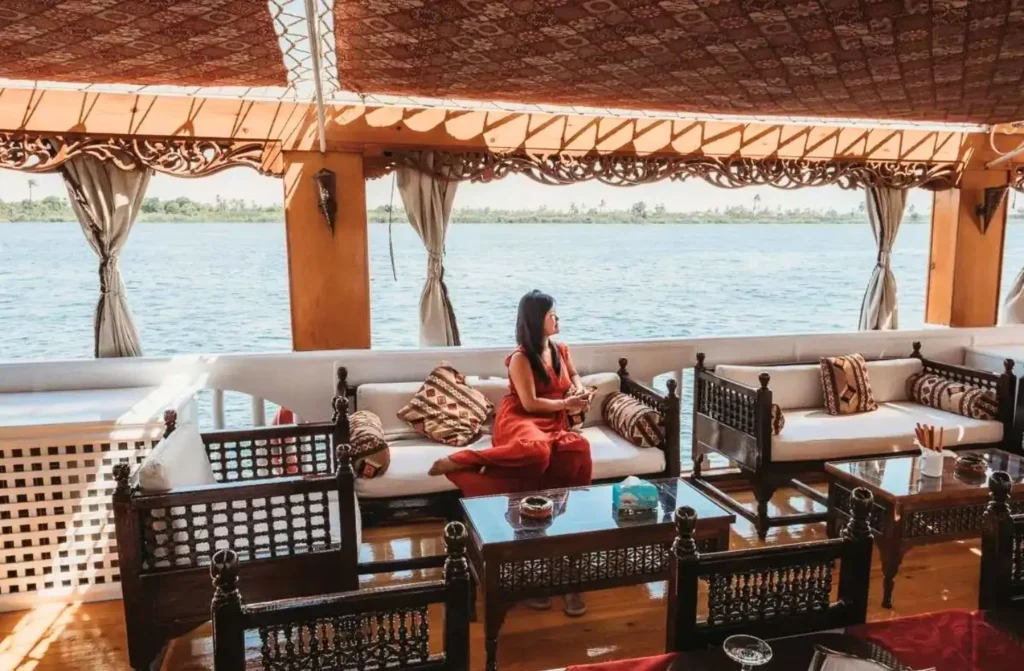
A dahabiya is a traditional two-masted wooden sailing boat — the name comes from an Arabic word roughly meaning “the golden one,” a nod to the private yachts once used by Egyptian nobility and wealthy 19th-century travelers, including, famously, Florence Nightingale and members of European aristocracy who sailed the Nile this way long before cruise ships existed.
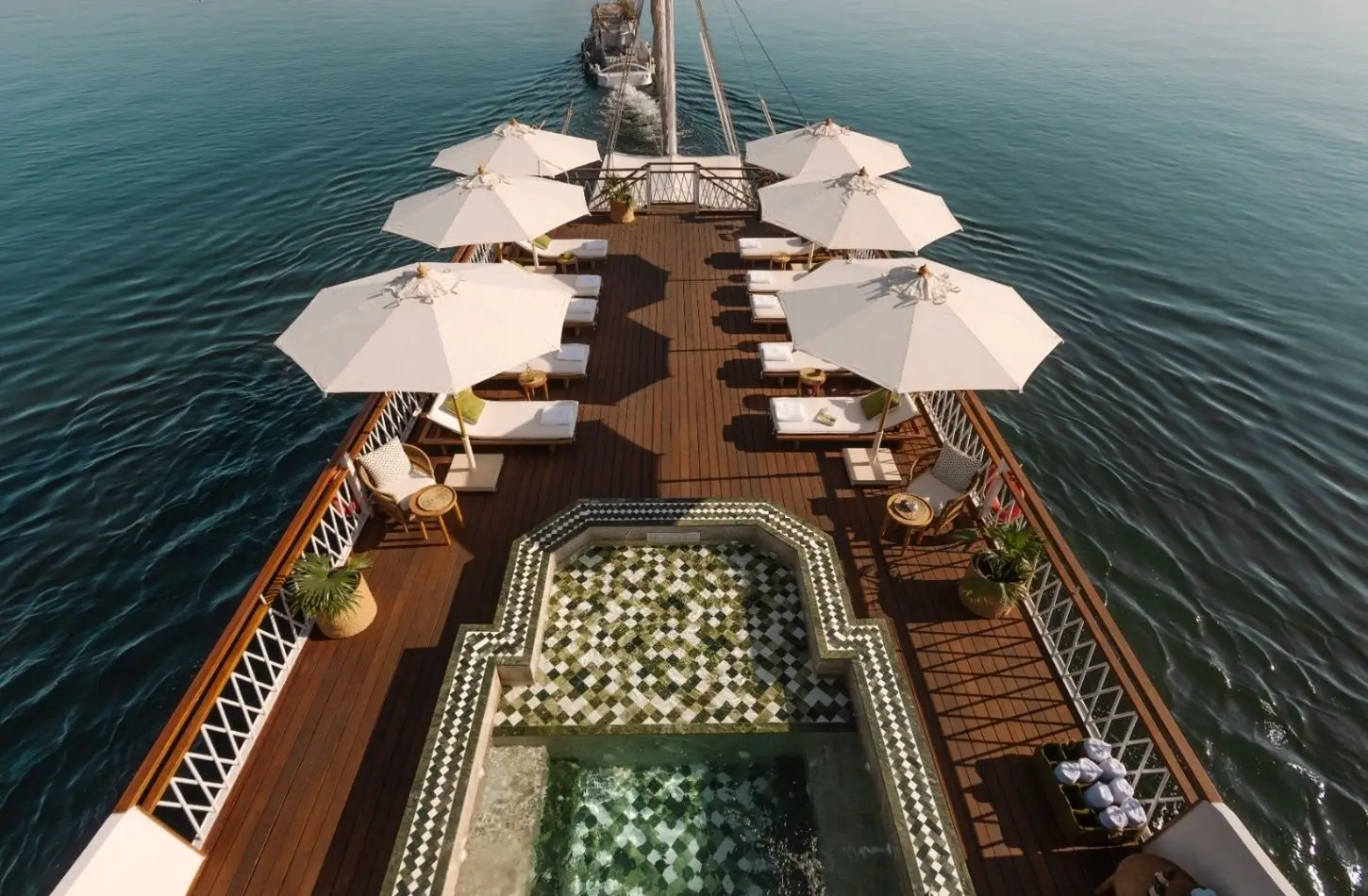
Modern dahabiyas keep that romantic shape but add the comforts people actually want: en-suite bathrooms, air conditioning, comfortable beds, and, on the nicer boats, a small plunge pool on the sun deck. What they don’t have is an engine doing the heavy lifting. Dahabiyas rely primarily on wind and sail, with a small tugboat positioned ahead to gently pull the vessel when the wind drops — which keeps the ride quiet but is worth knowing upfront so the “engine-free” reputation doesn’t overpromise. It’s not a technicality that ruins the experience; if anything, most travelers barely notice, but we’d rather tell you now than have you discover it on day two.
Capacity is the defining feature: usually 8 to 20 guests total. That’s small enough that you’ll know everyone’s name, the crew will know how you take your coffee, and the itinerary has real flexibility — if the light is perfect for photos at a temple, the boat can simply wait.
Nile Cruise vs Dahabiya: The Honest Difference Is Pace, Not Just Price
Every comparison article on Nile cruise vs dahabiya focuses on price. Fewer talk about what actually changes day to day, and that’s the part that determines whether you’ll love your trip or feel like you booked the wrong one.
On a Nile cruise, days follow a rhythm: an early wake-up call, a guided excursion before the heat sets in, a return to the ship for lunch, free time by the pool, another stop or free afternoon, dinner, entertainment. Sailing often happens overnight, so you cover distance while you sleep and wake up somewhere new. It’s efficient, and it works — especially if this is your first trip to Egypt and you want to see the greatest hits without wasting a single day.
On a dahabiya, the schedule bends to the wind and the water. Sailing happens mostly during daylight, so you’re actually on deck watching the riverbank change — palm groves, water buffalo, kids waving from the shore, the occasional felucca gliding past. If the wind is strong, you might cover ground quickly and arrive early; if it’s dead calm, you might stay moored an extra hour and nobody minds. There’s no entertainment program because the river is the entertainment. This pace either sounds wonderful or mildly frustrating depending on your personality, and that’s genuinely the crux of the whole decision.
Nile Cruise vs Dahabiya: What Each Boat Can (and Can’t) Reach
Both sides of the Nile cruise vs dahabiya debate sail the same 200-kilometer Luxor–Aswan corridor and stop at the same headline sites: Karnak and Luxor Temples, the Valley of the Kings, Edfu’s Temple of Horus, Kom Ombo, and Philae Temple near Aswan. If your only goal is to see those five or six places, either boat gets you there.
Where dahabiyas pull ahead is everything in between. Because they’re small, shallow-drafted, and don’t need a dock built for a five-deck ship, they can moor at spots larger vessels simply can’t reach:
- El Kab, an ancient site with rock-cut tombs, is rarely visited by big cruise groups.
- Gebel el-Silsila, sandstone quarries and shrines that supplied the stone for most of Egypt’s major temples, almost never on a standard cruise itinerary.
- Small riverside Nubian villages, where some dahabiya operators arrange informal stops for tea with local families.
- Quieter approaches to Edfu and Kom Ombo, arriving by felucca or on foot rather than in a queue of coaches.
None of this makes the headline temples better on a dahabiya — Karnak is Karnak either way. It means a dahabiya trip has more texture around the edges, which matters if this isn’t your first visit to Egypt or if “seeing something few other tourists see” is part of what you’re after.
Nile Cruise vs Dahabiya: What Each One Actually Costs
Prices vary by season, vessel quality, and trip length, but here’s a realistic breakdown by tier for a per-person, per-night rate:
Nile cruise:
- 3-star ships: roughly start at $50/night — basic but comfortable, good for budget-conscious first-timers
- 4-star ships: roughly start at $100/night — noticeably better cabins, food, and service
- 5-star ships: roughly start at $200/night — hotel-grade comfort, balconies, better excursions included
Dahabiya:
- Entry-level dahabiyas: roughly start at $250/night — still intimate, simpler decor, full board
- Mid-range dahabiyas: roughly start at $400/night — better cabins, sun deck lounges, sometimes a plunge pool
- Top-tier dahabiyas: roughly start at $700/night — refined interiors, chef-led dining, the most exclusive stops
A typical 4-night Nile cruise for two might land between $800 and $2,500 depending on star rating, while a 4- to 5-night dahabiya charter for two often starts around $2,000 and can run well past $6,000 on the most sought-after boats. That gap is real, and it’s the single biggest reason people default to a standard cruise — but it also explains why dahabiya travelers tend to be repeat Egypt visitors who’ve already ticked the major sites off their list and are now paying for the experience of the river itself, not just the destinations along it.
Private charter — booking the entire dahabiya for your group rather than sharing cabins with other travelers — is available on most vessels and is common for honeymoons, milestone birthdays, or family reunions. Our tailor-made tour team can build a private dahabiya charter or a fully custom Nile itinerary around specific dates and group sizes.
Nile Cruise vs Dahabiya: Which One Should You Actually Book?
This is the part most Nile cruise vs dahabiya comparisons skip. Instead of a vague “it depends on your style,” here’s how we’d actually match the boat to the traveler, based on years of putting both types of guests on the river.
You’re visiting Egypt for the first time. Book a Nile cruise. You have a long list of must-see sites, a limited number of days, and you want the itinerary handled efficiently. A 4- or 5-star ship gives you comfort, guided excursions to every major temple, and a social atmosphere without the premium price tag of a dahabiya. Save the slower, more exclusive experience for a return trip.
You’re on a honeymoon or a milestone trip. Book a dahabiya, ideally as a private charter. Few things beat watching the sunset over the Nile from a near-empty sun deck with a boat of eight cabins instead of eighty. It’s more expensive per night, but for a once-in-a-lifetime trip, the cost difference often pales in comparison to the memory. Our honeymoon packages can be built around a dahabiya sailing.
You’re traveling with an extended family or a larger group. Book a Nile cruise. The facilities — pool, multiple dining areas, and more space to spread out — are designed for groups with different ages and interests, and the fixed schedule makes coordinating a large group far easier than it would be on an 8-cabin boat.
You’re a repeat visitor, or you specifically want a slower, quieter trip. Book a dahabiya. If you’ve already seen Karnak and the Valley of the Kings and you’re coming back for the feeling of the river rather than a checklist of monuments, this is exactly what a dahabiya is built for.
You’re working with a tight budget but still want the Nile experience. Book a 3- or 4-star Nile cruise. It remains, by a wide margin, the more affordable way onto the water, and a well-run 4-star ship delivers a genuinely comfortable trip without the dahabiya price premium.
The Booking Trick Almost Nobody Mentions: Skip the Nile Cruise vs Dahabiya Choice and Do Both
Here’s something we rarely see written elsewhere, because most operators only sell one type of boat: in the Nile cruise vs dahabiya debate, the two options aren’t actually rivals, they’re sequential.
Travelers who fall in love with Egypt on a first Nile cruise very often come back specifically for a dahabiya, once the pressure to see every major site is off and they just want to experience the river itself.
If Egypt is a destination you already know you’ll revisit — or if you’re planning two trips in the same year, say a family trip and a couples trip — there’s a strong case for doing a standard cruise the first time and a dahabiya the second. You get the full highlight reel first, then the slow, intimate version once you already know what you’re looking at.
Practical Tips for Booking Either Option
Book earlier than you think you need to. Dahabiyas, in particular, have very few cabins, and the well-known vessels sell out two to three months in advance during peak season (October through April). Nile cruises have more capacity, but the better 5-star ships still fill up around the same window.
Match your season to your priorities. The cooler months, roughly November through February, are the most comfortable for daytime excursions on either type of boat. If you’re set on a dahabiya specifically for the sailing experience, ask about wind conditions for your travel month — some months are calmer than others, which affects how much of the journey is under sail versus tugboat assist. Our best time to visit Egypt guide breaks this down month by month.
Check what’s actually included. On both boat types, ask specifically whether entrance fees, guided excursions, and all meals are included in the quoted price — this varies more than travelers expect, and it’s the main reason two “similar” quotes can differ by hundreds of dollars.
Decide if you want shared or private. Nile cruises are almost always shared by default. Dahabiyas can be booked shared (cheaper, per cabin) or as a full private charter (the whole boat, for your group only) — worth asking about directly if privacy matters more than price.
Pair it with the rest of your Egypt itinerary. Most travelers combine their Nile sailing with time in Cairo and a look at Luxor’s temples and Aswan’s key sites before or after boarding. If you’re weighing a Nile sailing against a private, guide-led land tour of the same region instead, our comparison of group tours vs. private tours covers that decision too.
Frequently Asked Questions about Nile Cruise vs Dahabiya
What is the difference between a Nile cruise and a dahabiya?
A Nile cruise is a large, engine-powered ship carrying 50 to 150+ passengers with hotel-style facilities and a fixed schedule. A dahabiya is a small, traditional wooden sailboat carrying 8 to 20 guests, moving mainly by wind with a more flexible, personal itinerary.
Is a dahabiya more expensive than a Nile cruise?
Yes, generally two to three times more per night. A standard Nile cruise can run $50–$200 per person per night, while a dahabiya typically runs $250–$1,000+ per night depending on the vessel and season.
Which is better, a dahabiya or a Nile cruise?
Neither is objectively better — it depends on your travel style. Nile cruises suit first-time visitors, families, and travelers who want an efficient, sociable trip covering all the major sites. Dahabiyas suit couples, honeymooners, and repeat visitors who want a slower, more private, and flexible experience.
How many people fit on a dahabiya?
Most dahabiyas carry between 8 and 20 guests, with the more exclusive luxury vessels toward the smaller end of that range for a more private atmosphere.
Do dahabiyas sail on the Nile all year round?
Dahabiyas typically operate year-round, though sailing conditions and demand peak from October to April, when temperatures are cooler and wind conditions are more favorable for a true sailing experience.
Can you combine a Nile cruise and a dahabiya in one trip?
Not usually within the same sailing, since they follow different schedules and vessel types, but many travelers do both across separate trips — a Nile cruise on a first visit to see the major sites, and a dahabiya on a return trip for a slower, more intimate experience.
Nile Cruise vs Dahabiya: Ready to Choose Your Nile Journey?
Whichever way the Nile cruise vs dahabiya decision goes for you, both deliver the same magic — temples rising out of the desert, the river doing what it’s done for thousands of years — just at a different pace and price point. If you want the full highlight reel with hotel-grade comfort, explore our Nile cruise collection from standard to five-star. If the idea of a quiet wooden sailboat and a handful of fellow travelers sounds like your kind of trip, our dahabiya Nile cruises are worth a closer look. And if you’re still not sure which fits, our tailor-made tours team can walk you through both and build the itinerary around what actually matters to you.
Ready to Experience Egypt for Yourself?
Let our local experts turn these ideas into an unforgettable journey — guided, seamless, and tailored entirely around you.

