
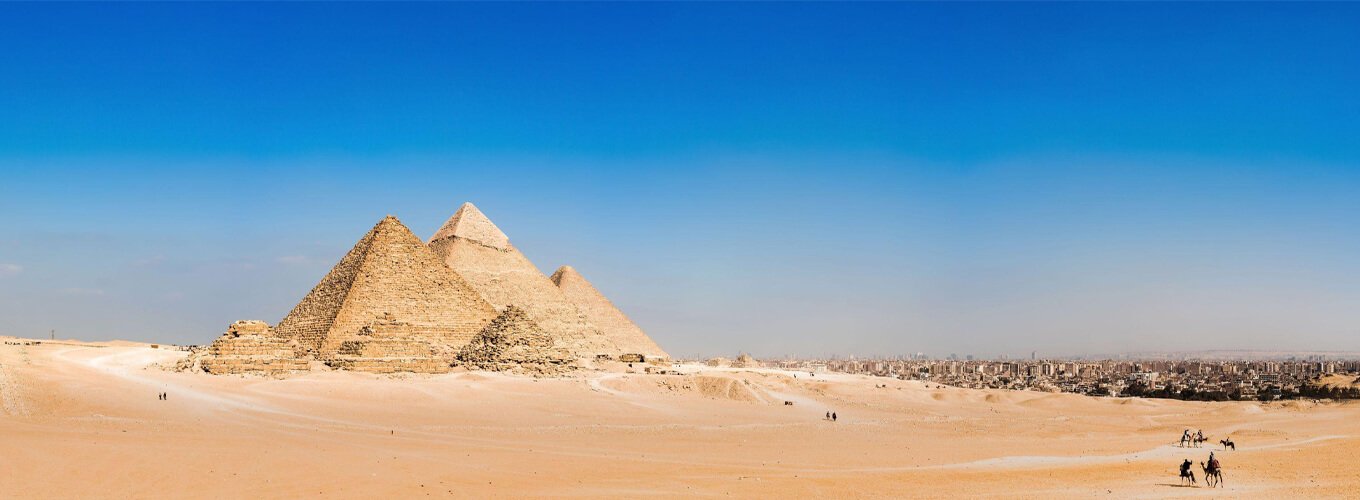
Egypt's Pyramids of Giza were built around 4,500 years ago during the Fourth Dynasty of the Old Kingdom, roughly 2600 to 2500 BC. The history of the Pyramids of Giza centers on three pharaohs, Khufu, Khafre, and Menkaure, who commissioned them as monumental royal tombs.
Few sights on Earth stop you in your tracks quite like standing before the Great Pyramid at dawn, watching the desert light slide across four and a half thousand years of stone. The history of the Pyramids of Giza is a story of ambition, engineering genius, faith and mystery that still refuses to give up all its secrets. As a local guide who has walked this plateau more times than I can count, let me take you through how these monuments came to be and why they continue to captivate the world.
A Plateau on the Edge of the Living World
The Giza Plateau sits on the west bank of the Nile, on the fringe of modern Cairo yet worlds away in spirit. For the ancient Egyptians, the west was the land of the setting sun and the realm of the dead, which made this rocky outcrop the perfect address for eternity.
What we now call the Giza necropolis was a carefully chosen site. The limestone bedrock was solid enough to bear colossal weight, the river ran close enough to float in enormous stone blocks, and the horizon offered an uninterrupted stage for the sun to rise and fall over the tombs of kings.
The Old Kingdom Kings Behind the Monuments
The three great pyramids belong to the Fourth Dynasty of Egypt’s Old Kingdom, a golden age of centralised power roughly 4,500 years ago. Three pharaohs left their mark here, each raising a monument that spoke of divine authority.
- Khufu (whom the Greeks called Cheops) built the Great Pyramid, the oldest and largest of the trio.
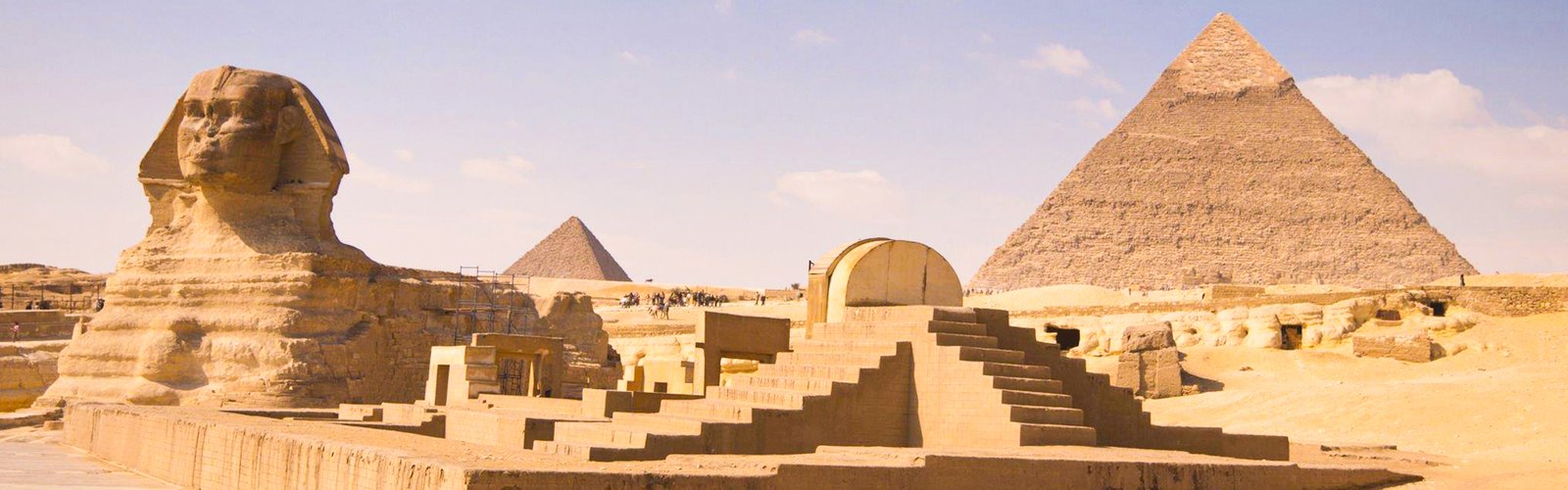
- Khafre, Khufu’s son, raised the second pyramid and is widely credited with the Great Sphinx that guards the plateau.
- Menkaure built the smallest of the three, a more modest but beautifully proportioned tomb.
Around these giants cluster smaller “queens’ pyramids,” mastaba tombs for nobles and officials, and the remains of temples and causeways. Giza was never a single project but a sprawling royal cemetery that grew across generations.
The Great Pyramid of Khufu: An Ancient Wonder
The Great Pyramid is the headline act, and rightly so. It stood as the tallest human-made structure on the planet for thousands of years, and it remains the only survivor of the original Seven Wonders of the Ancient World.
Built from millions of limestone and granite blocks, its base is astonishingly level and its sides align almost perfectly with the cardinal points of the compass. When it was finished, smooth white casing stones would have made it gleam under the Egyptian sun like a beacon visible for miles.
The Precision That Still Baffles Us
What impresses me most is not the size but the accuracy. The corners are near-perfect right angles, and the alignment to true north is off by only a whisker. Achieving this without modern instruments speaks to a mastery of astronomy, mathematics and surveying that we are still working to fully understand.
Who Really Built the Pyramids?
Let me put one myth to rest straight away. The pyramids were not built by enslaved foreigners toiling under the whip, a popular image that owes more to later legend than to evidence.
Archaeologists have uncovered the workers’ town near the plateau, complete with bakeries, breweries, dormitories and even a cemetery for the labourers. The bones tell of hard physical work but also of medical care and a diet rich in meat and bread, hardly the fare of slaves.
The builders were skilled craftsmen and seasonal labourers, organised into named teams that took genuine pride in their work. They were fed, housed and honoured by the state, and building the king’s eternal home was very likely seen as a sacred duty and a source of communal identity.
How the Pyramids Were Built
The precise construction methods remain one of history’s great puzzles, and honestly, a little mystery is part of the magic. What we do know is that the process was methodical rather than miraculous.
Blocks were quarried locally for the core and floated down the Nile from Aswan for the finer granite. Teams likely hauled the stones up long ramps of mud, rubble and brick, lubricating the ground with water to reduce friction, a technique hinted at in ancient wall paintings.
- Quarrying the limestone core close to the site to reduce transport.
- Shipping fine granite from the south, near what is now the base for many Aswan tours.
- Ramping and levering the blocks into place, layer by layer.
- Casing and polishing the outer surface to a smooth, dazzling finish.
It was, above all, a triumph of organisation. Feeding, housing and coordinating tens of thousands of people for decades was arguably a greater feat than the stonework itself.
The Great Sphinx and the Guardian of Giza
No visit to the plateau is complete without meeting the Sphinx, that enigmatic lion-bodied figure with a human face gazing eternally towards the rising sun. Carved from a single ridge of natural limestone, it is one of the largest and oldest monumental sculptures in the world.
Most scholars link the Sphinx to Khafre, seeing his features in its weathered face, though debate rumbles on about its exact age and purpose. Over the centuries it was buried up to its neck in sand, and a famous ancient inscription tells of a prince who cleared it after the Sphinx promised him the throne in a dream.
Inside the Pyramids: Chambers, Passages and Purpose
Step inside the Great Pyramid and you enter a world of narrow passages and soaring galleries. The Grand Gallery, with its high corbelled ceiling, leads up to the King’s Chamber, a stark granite room that once held Khufu’s sarcophagus.
Above the burial chamber sit clever relieving chambers designed to distribute the crushing weight of the stone. Narrow shafts point outwards towards the stars, and their purpose, whether practical ventilation or a spiritual pathway for the king’s soul, remains a wonderful subject of debate.
Why the Egyptians Built Them
Ultimately, the pyramids were tombs and resurrection machines. The Egyptians believed the pharaoh was a living god who would rejoin the sun and the stars after death, and the pyramid was the launchpad for that eternal journey.
The shape itself may echo the mound of creation or the rays of the sun spreading to the earth. Every corridor, chamber and treasure was designed to protect and provision the king for a life beyond life.
Rediscovery, Exploration and Enduring Mysteries
The Pyramids of Giza never truly disappeared, but interest in them ebbed and flowed across the ages. Greek and Roman travellers marvelled at them, medieval writers speculated wildly, and by the modern era they had become a magnet for explorers and scholars.
Napoleon’s expedition at the turn of the nineteenth century brought a wave of scientific study, and generations of archaeologists have been sifting the plateau ever since. Even today, cutting-edge scanning technology continues to reveal hidden voids and unexplored spaces deep within the stone.
That blend of hard science and lingering mystery is exactly why the history of the Pyramids of Giza never grows stale. Each answer seems to open another question.
How the Pyramids Shaped Egyptian Civilisation
The pyramid age left a legacy far beyond the plateau. Building on this scale demanded advances in mathematics, engineering, logistics and administration that rippled through Egyptian society for centuries.
Later pharaohs eventually abandoned pyramids in favour of hidden rock-cut tombs, most famously in the Valley of the Kings near Luxor. If Giza sparks your curiosity about how royal burial evolved, the temples and tombs explored on our Luxor tours tell the next chapter of the story beautifully.
The pyramids also cemented Egypt’s identity as a land of monumental ambition, an image that still draws travellers from every corner of the globe.
Visiting the Pyramids of Giza Today
Standing where I do, watching visitors take their first look at the plateau, I can tell you the monuments lose none of their power up close. Here are a few friendly tips to make the most of your time there.
- Go early or late to dodge the midday heat and the thickest crowds, and to catch the softest light for photographs.
- Wear sturdy shoes, as the ground is sandy, uneven and often steep.
- Carry water and sun protection, since there is little shade on the open plateau.
- Consider a knowledgeable guide, because the stories behind the stones bring the whole site to life.
The pyramids pair naturally with the treasures of the capital, from the museums to the medieval streets of Islamic Cairo. Our Cairo tours weave these highlights together so nothing important slips past you, and if you have only a day to spare, our Egypt day trips make it easy to see Giza without the stress of planning.
Making the Pyramids Part of a Bigger Journey
For many travellers, Giza is the opening act of a grand tour that continues south along the Nile. Combining the plateau with a river voyage or a longer itinerary turns a single unforgettable morning into the trip of a lifetime.
If you would like Giza to sit at the heart of a wider adventure, our Egypt travel packages stitch together the pyramids, ancient temples and timeless landscapes into one seamless journey.
Why the Pyramids Still Captivate the World
So what is it about these ancient tombs that keeps us spellbound? Part of it is scale, part is age, and part is that irresistible sense of standing in the presence of something far larger than ourselves.
The Pyramids of Giza are a bridge across time, built by human hands yet almost superhuman in achievement. They remind us that ordinary people, working together with vision and skill, can create wonders that outlast empires.
Every sunrise over the plateau feels like a small miracle, and every visitor leaves a little changed by it. That, more than any statistic, is the true measure of their greatness.
Plan Your Own Pyramids Adventure
The captivating history of the Pyramids of Giza is best understood not from a page but from the plateau itself, with the desert wind in your hair and the great stones rising above you. There is simply no substitute for being there in person.
When you are ready to trade the guidebook for the real thing, we would love to help you plan every detail. Explore our range of experiences or let us build something just for you with our tailor-made Egypt tours, and let Daily Pyramids Tours turn your dream of Giza into a journey you will treasure forever.
Ready to Experience Egypt for Yourself?
Let our local experts turn these ideas into an unforgettable journey — guided, seamless, and tailored entirely around you.